
20+ live lessons for Pre-K–12
Each lesson is taught in person by one of our educators using Starry Night planetarium software and 360° projection inside the dome.
Live lessons
20+ NGSS-aligned lessons, taught in the dome by our educators.
Full-dome films
Prerecorded 360° titles, licensed from the world’s leading science centers.
What we teach
Browse the listings below and choose lessons for your students, or let us select engaging, age-appropriate topics. Pick different lessons for different groups, or one favorite for the entire school to experience.
Night and Day
Earth’s rotation creates day and night, and makes the Sun, Moon, and stars appear to move.
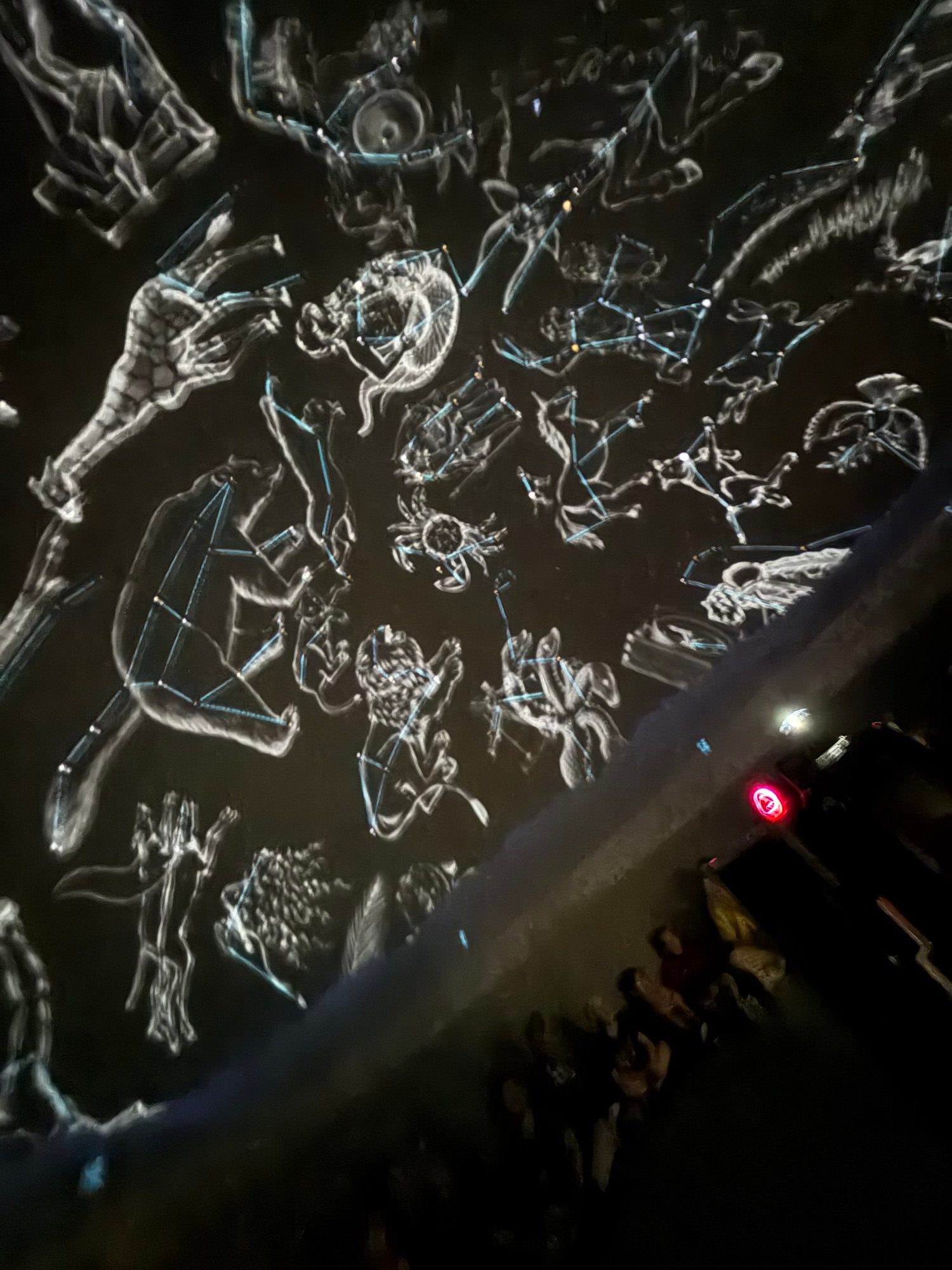
Constellation Myths
Constellation stories from different cultures connect the pictures in the sky with human legend.
The Planets
A closer look at each planet’s characteristics and its most notable moons.
Moon Phases
The Moon’s changing appearance comes from its monthly orbit around Earth.
Finding Your Way Around the Sky
Simple star patterns like the Big Dipper, and how to use Polaris to find north.
Solar System Overview
A tour of the Sun, the planets, and small bodies, plus the overall layout of the Solar System.
A Real Total Solar Eclipse
How solar eclipses work, how to view them safely, and what the 2017 U.S. eclipse looked like.
A Change of Season
Earth’s tilt and revolution change the Sun’s angle and daylight hours, producing the seasons.
Eclipses
The Sun–Earth–Moon geometry that creates solar and lunar eclipses, partial and total.
Meteors, Asteroids, and Comets
What they are, where they come from, and why meteor showers happen when they do.
Milky Way Galaxy
The structure of our galaxy, our place in it, light pollution, and neighboring Andromeda.
Astronomy of the Americas
Indigenous sky knowledge from across the Americas, including Hupa, Plains peoples, Ancestral Puebloan, Maya, and Inca traditions. A longer lesson, shortened to the grade-appropriate portion for your students.
Planetary Motion
Why planets appear to move backward, and how the heliocentric model explains retrograde motion.
Seasonal Constellations
Which constellations are visible in each season, including circumpolar stars and the zodiac band.
Lifecycle of Stars — Beginnings
How stars form out of interstellar gas and dust clouds and become protostars.
Star Properties and Life Cycle
Brightness, size, color, fusion — and how a star’s mass determines its whole life path.
Orders of Magnitude
A powers-of-ten journey from Earth out to galaxies, to get a feel for the scale of the universe.
Exoplanets
How we detect planets around other stars, and how we judge which might be habitable.
Lifecycle of Stars — Birth
Fusion ignition, main-sequence equilibrium, and why some objects end up as brown dwarfs.
Lifecycle of Stars — Low Mass Stars
The evolution of red dwarfs and their long path to white — and eventually black — dwarfs.
NGSS-aligned lessons
Our programs support Next Generation Science Standards and state science standards for Earth and space science.
- Content can be tailored by grade level, curriculum goals, or current events—such as an eclipse or a rocket launch in the news.
- Lessons are scripted to align with NGSS, while our educators answer questions as time allows and adapt each presentation to the group.
- Book us multiple times in one year and you still won’t run out of material.
This is a guide, not a hold. We confirm every date by email.
Bring the universe to your students
Tell us your preferred date and we’ll be in touch with availability and pricing—usually within one business day. We look forward to bringing the universe to you.
Or email hello@galaxyonthego.com · call (847) 920-STAR